
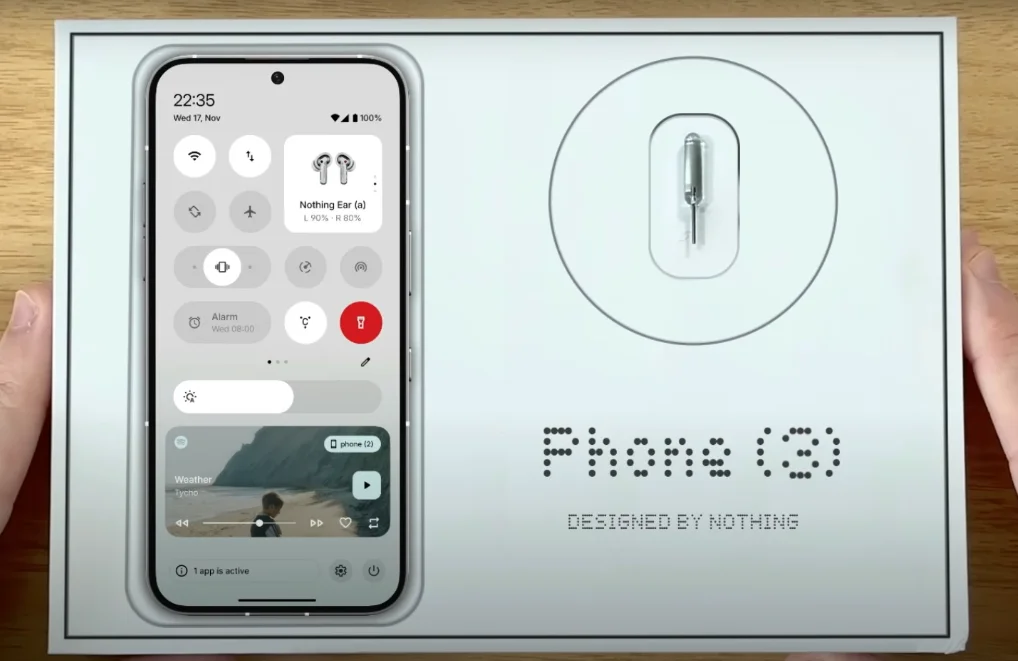
They say third time’s the charm – and Nothing is certainly banking on that with the launch of its latest handset, the Nothing Phone (3). Building on the success of the eye-catching Phone (1) and the performance-focused Phone (2), this new iteration takes the company’s bold design philosophy a step further into premium territory. At the same time, it fine-tunes the core formula that initially put the brand in the spotlight.
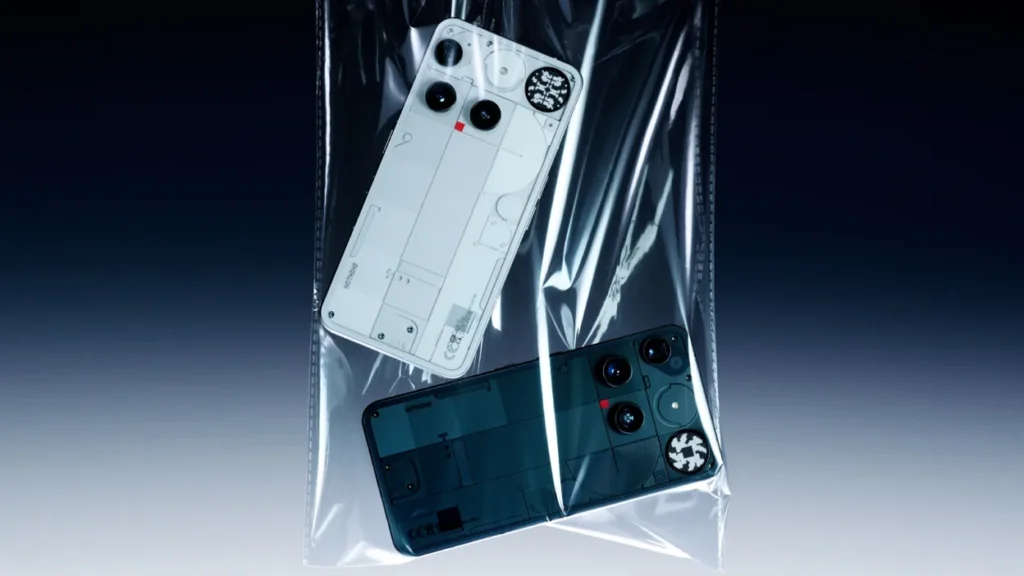
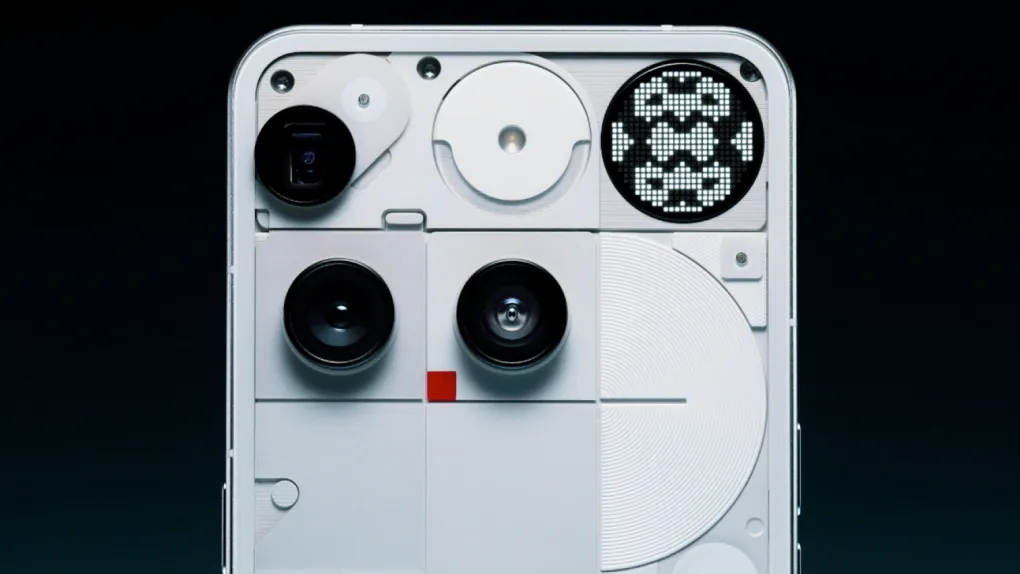
Externally, the Phone (3) continues with Nothing’s now-iconic transparent design, but introduces some fresh refinements. The most striking update is the new Glyph Matrix on the back – a modern reinterpretation of the brand’s distinctive lighting interface. Gone are the old LED strips, replaced by a dot-matrix display that brings a new level of interactivity and personalisation to notifications and alerts.
The chassis now features a flatter, more angular design, giving the Phone (3) a sharper and more refined look. It retains a premium feel, thanks to the use of an aluminium frame, Gorilla Glass Victus on the rear, and Gorilla Glass 7i on the front – continuing the high-quality build standard set by its predecessor.
Beneath the surface, Nothing has chosen the Snapdragon 8s Gen 4 chipset – a solid sub-flagship SoC that offers a smart balance between performance and power efficiency. It’s coupled with up to 16GB of RAM and a generous 5,150mAh battery, marking a noticeable improvement over previous generations. The addition of 65W fast charging ensures rapid recharges with minimal downtime.
The display sees a notable upgrade, now boasting a 6.67-inch OLED panel with peak brightness reaching up to 4,500 nits, along with slimmer bezels than ever before for a more immersive viewing experience. On the camera front, Nothing has stepped things up by introducing a third rear lens – a 50MP 3x periscope telephoto – joining the existing 50MP main and 50MP ultrawide sensors, delivering greater versatility for photography enthusiasts.
📱Nothing Phone (3) Full Specifications Table
| Category | Details |
|---|---|
| Body | 160.6 x 75.6 x 9.0 mm, 218g |
| Glass front (Gorilla Glass 7i), glass back (Gorilla Glass Victus), aluminium frame | |
| Monochrome LED display on the back (489 LEDs: notifications, timer, flashlight) | |
| IP68 dust-tight and water-resistant (up to 1.5m for 30 minutes) | |
| Display | 6.67″ OLED, 1 billion colours, 120Hz refresh rate, 960Hz PWM, HDR10+ |
| Peak brightness: 4500 nits | |
| Resolution: 1260 x 2800 pixels, 20:9 aspect ratio, 460ppi | |
| Chipset | Qualcomm Snapdragon 8s Gen 4 (4nm) |
| Octa-core: 1×3.21 GHz Cortex-X4 + 3×3.0 GHz Cortex-A720 + 2×2.8 GHz Cortex-A720 + 2×2.0 GHz Cortex-A720 | |
| GPU: Adreno 825 | |
| Memory & Storage | 256GB 12GB RAM / 512GB 16GB RAM |
| Storage Type: UFS 4.0 | |
| Operating System | Android 15 with Nothing OS 3.5 |
| Up to 5 major Android version upgrades | |
| Rear Cameras | 50 MP (wide), f/1.7, 24mm, 1/1.3″, PDAF, OIS |
| 50 MP (telephoto), f/2.7, 1/2.75″, PDAF, 3x optical zoom, OIS | |
| 50 MP (ultrawide), f/2.2, 114°, 1/2.76″ | |
| Front Camera | 50 MP (wide), f/2.2, 1/2.76″ |
| Video Recording | Rear: 4K @30/60fps, 1080p @30/60fps, with gyro-EIS & OIS |
| Front: 4K @60fps, 1080p @60fps | |
| Battery | 5150mAh |
| Charging: 65W wired (PD3.0, PPS, QC4), 15W wireless | |
| Reverse Charging: 7.5W wired, 5W wireless | |
| Connectivity | 5G, eSIM support, Wi-Fi 7, Bluetooth 6.0, NFC |
| Extras | Under-display optical fingerprint reader |
| Stereo speakers | |
| Circle to Search feature |
Design, Build Quality & Handling
If there’s one word that sums up the design of the Nothing Phone (3), it’s definitely ‘different’. While Nothing has always set itself apart through unique aesthetics, the Nothing Phone (3) takes this distinctiveness up a notch.
From the back, the design is a curious mix of symmetry and asymmetry. At a glance, it seems as if the rear has been split into three equal vertical columns – a clean idea, if not for the slightly awkward positioning of the top-left camera module, which disrupts the balance. It’s a bold look – one that might not be to everyone’s taste, but it can grow on you with time.
Nothing Phone (3) Gone are the original LED glyph strips that defined earlier models. Instead, you now get a revamped Glyph Matrix – a monochrome dot-matrix display made up of 489 individual LEDs. It’s more than just a notification gimmick. Users can assign custom animations, app-specific visuals, and even quirky games like Spin the Bottle, Rock Paper Scissors, and Magic 8 Ball. With a developer SDK on the horizon, there’s potential for even more creative uses to come.
Further down the rear, beneath the Glyph Matrix, sit two circular elements – one of which is a capacitive touch button. It’s an interactive controller for the Glyph display, offering haptic feedback and allowing you to engage directly with the screen content.
Elsewhere on the back, design takes centre stage. The red recording indicator light from the Phone (2) returns, adding to the already busy aesthetic. While some may find it chaotic, it’s a part of the phone’s character.
That said, the back panel is a fingerprint magnet. Unless you use a case, keeping it smudge-free is virtually impossible. The device comes in classic Black and White, sticking to Nothing’s minimalist colour approach – thankfully less loud than the design itself.
The back is made from Gorilla Glass Victus, and while a bit slippery, the Nothing Phone (3)’s angular frame and boxy shape offer a secure, confident grip. The front panel is protected by Gorilla Glass 7i, sandwiching an aluminium frame that gives the handset a solid, well-built feel. There’s no noticeable flex, no hollowness – just premium build quality through and through.
Another significant upgrade is its IP68 rating for dust and water resistance – a notable step up from the IP54 rating on the Phone (2). That means the Phone (3) can survive submersion in up to 1.5 metres of water for 30 minutes.
Button layout is slightly unconventional. The power button sits on the right, while the volume buttons are on the left – a setup that might take a bit of getting used to. We did wish the volume buttons were placed slightly higher for easier access, but the layout works well in landscape mode, especially for gaming.
There’s also a new “Essential Key” positioned just below the power button, designed as a shortcut to some of Nothing’s built-in AI features – we’ll touch more on that in the software section.
At the top, you’ll find a secondary speaker grille, helping to create a more balanced stereo effect with the main bottom-firing speaker. The sound projects both upwards and forwards, improving the overall audio experience. Along the bottom edge, there’s the USB-C port and a dual Nano-SIM tray – though sadly, there’s no microSD support for storage expansion.
The bezels around the display have been further slimmed down compared to the Phone (2), making for a sleeker front. All sensors are cleverly tucked away under the display, giving the phone a clean, uninterrupted look.
As for unlocking, the Phone (3) features a fast and reliable optical in-display fingerprint sensor. Our only gripe? It’s positioned a bit low on the screen, which may take some adjustment.
Connectivity
The Nothing Phone (3) is a dual-SIM 5G handset, offering SA/NSA Sub-6 support on both Nano-SIM slots. It also supports eSIM functionality, with the ability to operate two eSIMs simultaneously, providing excellent flexibility for international and multi-network users.
For positioning, Nothing Phone (3) offers comprehensive coverage with dual-band GPS (L1+L5), alongside support for GLONASS, BDS, GALILEO, QZSS, NavIC, and SBAS, ensuring precise and reliable location tracking.
In terms of local connectivity, the Phone (3) includes tri-band Wi-Fi 7, incorporating access to the less congested 6GHz band for faster and more stable connections. There’s also Bluetooth 6.0 with Low Energy (LE) support and NFC for seamless contactless payments and quick device pairing.
However, the device omits a few legacy features – there’s no FM radio, 3.5mm headphone jack, or IR blaster.
Display
The Nothing Phone (3) comes equipped with a vibrant 6.67-inch ALED display that supports a smooth 120Hz refresh rate. With a resolution of 1260 x 2800 pixels, the screen delivers a pixel density of approximately 460ppi, making it impressively sharp and ideal for both content consumption and everyday use. The panel is protected by the durable Gorilla Glass 7i, ensuring added resistance against scratches and minor drops.
Nothing claims that the display can reach a peak brightness of 4,500 nits, likely in a limited portion of the screen – a figure that certainly supports its HDR10+ certification, enhancing contrast and colour performance for compatible content.
In our standardised brightness tests, the display reached 756 nits at full manual brightness, while the auto-brightness mode peaked at an impressive 1,507 nits. These results mean the Phone (3)’s screen remains clear and easy to read, even in bright outdoor conditions – a real plus for everyday usability.
Refresh Rate
Unfortunately, the Nothing Phone (3) does not feature LTPO technology, relying instead on LTPS. As a result, it only supports refresh rates of 60Hz, 90Hz, and 120Hz, with no capability to drop below 60Hz – a slight letdown for those expecting more advanced adaptive refresh rate management.
The phone offers three display modes: Standard, Dynamic, and High. The Standard mode locks the refresh rate at 60Hz for consistent battery saving. Dynamic and High modes introduce some level of automatic adjustment. In both, the user interface runs at 120Hz during active interaction, before dropping quickly to 60Hz when idle. Most apps typically cap at 90Hz and may occasionally reduce to 60Hz, depending on usage.
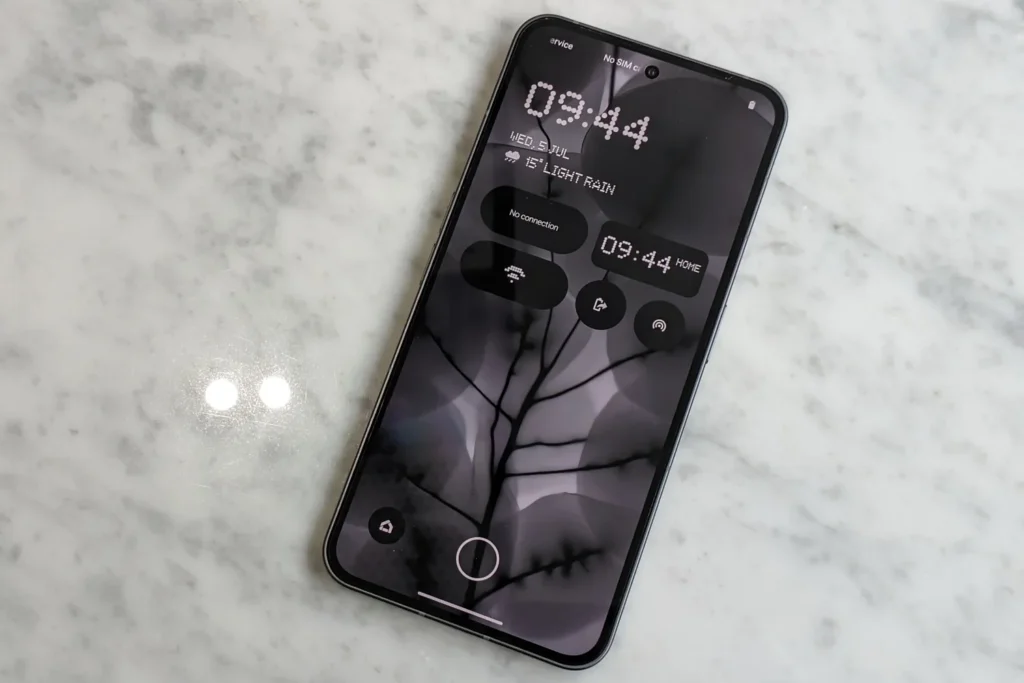
While High mode leans slightly more towards maintaining higher refresh rates, the practical difference between it and Dynamic is minimal in day-to-day use. Overall, while smooth enough for general use, the lack of lower refresh rate scaling is a missed opportunity for power efficiency.
HDR and Streaming
As noted, the Nothing Phone (3) is fully HDR10+ certified, with the device supporting HDR10, HDR10+, and HLG formats. However, it does not support Dolby Vision.
On the streaming front, we’re pleased to confirm that the phone is equipped with Widevine L1 DRM certification, enabling full-resolution playback on popular platforms like Netflix, Prime Video, and others – ensuring a premium viewing experience for HDR content.
Battery Life
The international variant of the Nothing Phone (3) houses a 5,150mAh battery, while the Indian model features a slightly larger 5,500mAh capacity.
In our standardised battery tests, the Phone (3) delivered decent, though not class-leading performance. It achieved an Active Use Score of 12 hours and 56 minutes – respectable for most users, but not quite at the top of its category. The combination of the ALED display and power-efficient chipset helps maintain consistent all-day battery life in typical usage scenarios.
Software
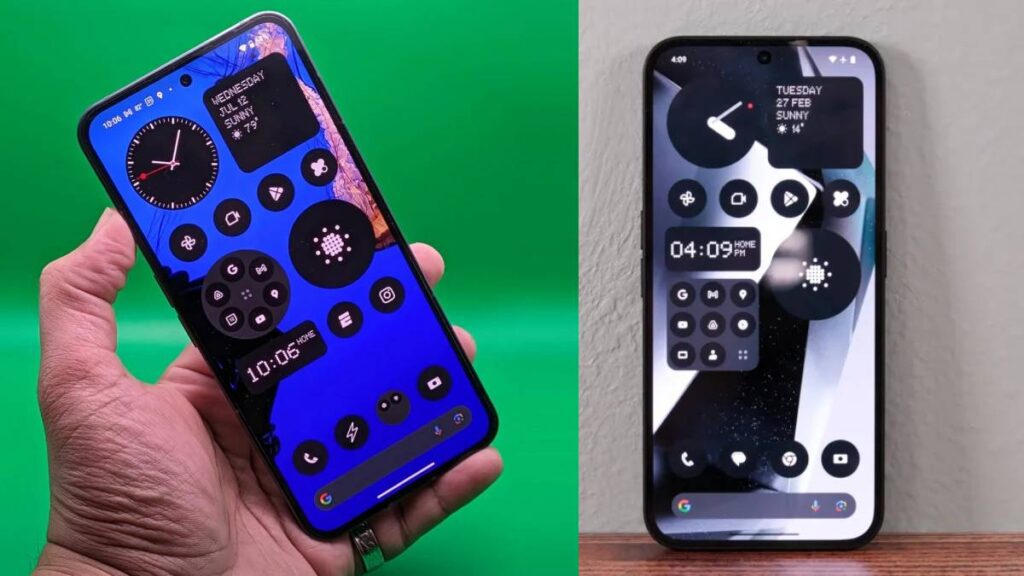
True to form, the Nothing Phone (3) runs on the brand’s custom Nothing OS, which in this case is version 3.5, layered over Android 15 on our review unit.
Nothing has committed to delivering up to five major Android updates, offering impressive long-term software support that rivals most flagship devices.
While Nothing OS is undeniably stylish and design-led, it goes beyond being just a visual skin. It includes a range of custom features, smart optimisations, and thoughtful tweaks that add to both usability and performance, making the software experience distinctively Nothing.
A Potent Triple‑Camera Setup
The Nothing Phone (3) brings a notable upgrade in photography, thanks to the addition of a dedicated 3× periscope telephoto lens, making it a clear step up from its predecessor.
All three rear cameras share a 50 MP resolution:
- Main (wide): OmniVision OV50H, f/1.7, 1/1.3″ sensor with PDAF and OIS — excellent for 4K video at 60 fps.
- Telephoto: Samsung ISOCELL JN5, f/2.7, 3× optical zoom with PDAF and OIS — ideal for portraits and distant subjects.
- Ultrawide: Samsung ISOCELL JN1, f/2.2, 114° field of view — wide and vivid but a little less sharp in detail.
The 50MP front camera also uses the Samsung ISOCELL JN1 sensor (f/2.2). While it delivers detailed selfies, it lacks autofocus, which can affect close-up clarity.
The camera app is clean and intuitive—light on fancy extras, but well-designed for everyday use.
Daylight Photo Quality
By default, images from the main camera are binned down to 12.5 MP, resulting in balanced colour tones and pleasing overall clarity. Fine-detail precision is decent, though not quite at the top tier—there’s a touch of softness noticeable under close inspection.
You can force full 50 MP captures, which tend to look more natural with subtler processing. However, they reveal less sharpness on fine lines due to reduced edge enhancement.
Portrait shots shine with true-to-life skin tones and effective subject separation, including smooth and natural bokeh at both 1× and 2× zoom.
Telephoto Performance
The 3× telephoto lens performs well in everyday situations. While not the sharpest in its class, images generally look clean unless heavily scrutinised. Zoom-to-6× digital range remains usable, though detail softens noticeably.
Macro shots taken with the telephoto lens impress—sharp and detailed, showing off its versatility.
Ultrawide Shots
The 50 MP ultrawide captures vibrant images with good dynamic range and accurate colours. However, detail resolution lags behind rival sensors, leaving some areas looking smoother or algorithmically processed. Autofocus would have helped, but the output is still solid for wide-angle scenarios.
Selfie Camera
The front-facing camera delivers 50 MP images by default. Selfies appear sharp and punchy, with pleasing skin tones and colour accuracy. Though autofocus is absent, its wide focal plane means most shots remain in focus, even with close framing. Night-time selfies benefit greatly from the effective screen flash.
Low-Light Performance
- Main camera: Delivers impressive low-light shots with minimal noise and strong dynamic range. Slight sharpening is noticeable but doesn’t detract. Built-in night mode achieves similar results to auto mode.
- 2× zoom in low light: Some noise and smoothing are visible, but images remain usable.
- Telephoto low light: At 3× zoom, images are cleaner and better lit; 6× digital zoom preserves surprising clarity with minimal noise.
- Ultrawide low light: Colours and exposure hold up well, but detail softness is more apparent here.
- Selfies in darkness: Show solid colour and clarity, with screen flash helping preserve facial features effectively.
Video Capture Quality
The Nothing Phone (3) records in H.264 (AVC) widescreen MP4 by default, with optional HEVC (H.265) for smaller file sizes at the same visual quality. Capturing is available at 4K @ 60 fps using either Codec, ensuring rich detail and smooth playback.
Pros
- Distinctive and eye-catching design, now with IP68 water resistance and Gorilla Glass protection.
- Excellent performance in short bursts – snappy and responsive.
- Bright, crisp OLED display with HDR10+ certification and impressive peak brightness.
- Versatile triple-camera system, including a dedicated telephoto lens.
- Clean, fast Nothing OS with long-term Android update promise and unique Glyph/AI features.
- Impressive stereo speakers and a solid all-round multimedia experience.
Cons
- LTPS display lacks LTPO support, limiting adaptive refresh rate capabilities.
- Battery life and charging speeds are only average relative to its price tag.
- Thermal throttling is evident during sustained performance – could affect gaming or heavy tasks.
- Premium pricing, especially when compared to more fully equipped rivals in the same category.